Showing posts with label 5G. Show all posts

Friday, March 10, 2017

Have we taken computing, bit storage and bit transport for granted?

If you over heard the terms IoT (internet of Things), AI (Artificial intelligence),  VR (Virtual Reality), AR (Augmented Reality), AV (Autonomous Vehicles) and many others alike, during the past couple of years, especially in the beautiful city of Barcelona - if you happened to be at MWC (Mobile World Congress) 2017, then you’re not the only one. Celicitaciones! (On a different note, I also thought to myself that the abbreviations are also becoming shorter – 2 letters instead of 3 /4 letters).

All of a sudden, the terms we used to hear and discuss often – like IP (Internet Protocol), Ethernet, MPLS (Multi-Protocol Label Switching) - in the Telecom industry have been replaced by a set of more sexy terms like IoT, AI, VR, AR, AV, etc. These new techs have also broken the boundaries of traditional Telco industry and many cross disciplines – like medical, education, transportation, trading, finance, etc.- have been interconnected like never before.
But, one thing that most of the new technologies seems to be taken for granted is the presence of readily available underlying infrastructure, mainly consist of computing, bit storage and bit transport. These are the three fundamental tasks we have been doing in the entire history of ICT (Information and Communications Technology). No doubt that these three areas have also been improved and matured over the years and today we have super computers capable of super-fast computing,  DCs (Data Centers) with massive capacities and networks with Terabit bandwidths.

However, as IoT, AI, VR, AR, AV, etc, are commoditizing and commercializing in a rapid pace than we thought, can we simply take the infrastructure for granted? The size and shape of different vectors like scale, capacity, responsiveness, etc. on the infrastructure to support the requirements of overlay services/applications might suddenly create catastrophes, if we do not prepare ourselves today. It’s a good sign that we now see, at least in small scale, some discussions happen across these areas. Don’t be surprised the next time you go to an optical conference, and you hear someone talking about VR/AR.
What is required is a more collaborated discussions and researches to view and address the total requirement as a whole, making sure to include all the stakeholders. These stakeholders surely will not come entirely from telecom domain, but from different other domains we might never have thought of.

Wednesday, March 8, 2017

In search of a Multiple Access Scheme (MAS) for 5G


5G – the 5th Generation mobile technology might arrive at our door steps sooner than we think, supporting 3 typical usage scenarios: enhanced Mobile Broadband (eMBB), massive Machine Type Communication (mMTC) and Ultra-reliable Low Latency Communication (URLLC) [1]. Though architecture wise 5G is different from its predecessors, like in any other wireless communication technology, among many other things, the Multiple Access Scheme (MAS) becomes the key for 5G and selecting the suitable scheme will ultimately decide the future and success of 5G.

MAS (aka Multiple Access Method or Channel Access Method) is required when we have to share a physical media. This is not only applicable to wireless, but also to many wired networks including bus networks and ring networks. In wireless, MAS allows several User Equipment (UE) connected to the same multi-point transmission medium to transmit over it and to share the available radio capacity. MAS is based on a multiplexing method, allowing several data streams or signals to share the same communication channel or physical medium.

Multiplexing or muxing works by combining multiple analog or digital signals into one signal over a shared medium. Space Division Multiplexing (SDM), Frequency Division Multiplexing (FDM), Time Division Multiplexing (TDM) and Code Division Multiplexing (CDM) are some examples. Therefore the MAS using FDM becomes Frequency Division Multiple Access (FDMA), TDM becomes Time Division Multiple Access (TDMA) and CDM becomes Code Division Multiple Access (CDMA).  In FDMA, each user has a small part of the resource (spectrum) allocated all the time. In TDMA, each user has nearly all the spectrum allocated at a small duration of time. In CDMA, each user has all the spectrum all the time. While multiplexing is provided by the physical layer, multiple accesses also involves Media Access Control (MAC) layer.

So, in summary, Multiplexing is combining many signals on one media, while MAS is allowing many to access the media/resource at one time. Therefore, it can be stated that Multiplexing is a technique and multiple accesses is the way to use that technique.

Over the years, different generations of mobile technologies used different MASs to achieve different capabilities, more importantly the system capacity and spectral efficiency. 

Generation
MAS
Application
1G
FDMA
AMPS
2G
TDMA
GSM
3G
CDMA
UMTS
4G
OFDMA
LTE
Note: AMPS-Advanced Mobile Phone System, GSM-Global System for Mobile communications, UMTS-Universal Mobile Telecommunications System, LTE-Long Term Evolution

All the above MASs (except CDMA), which can be called as conventional MASs, are Orthogonal Multiple Access (OMA) technologies.  In OMA, different users are allocated to orthogonal resources in either time, frequency or code domain in order to mitigate Multiple Access Interference (MAI). As the expectations or the objectives of 5G (higher data rates – 100/1000 times 4G, low latency – 1ms Round Trip Time (RTT), massive connectivity, high density – 1M devices/km^2, enhanced indoor coverage etc.) are quite different from that of 4G and others, the Radio Access Technology (RAT), which is characterized by MAS, need to be flexible, reliable, energy efficient, spectral efficient and support diverse Quality of Service (QoS). OMA schemes are not sufficient to support these requirements, especially massive connectivity and diverse QoS. [2], [3], [4]

It’s worthwhile to look little deeper on the scenario of mMTC and why the current LTE or LTE- Advanced (LTE-A) will find it difficult to support mMTC. In LTE/LTE-A there are lot of interactive processes between the Node B (NB)/enhanced NB (eNB) and the UE before data is transmitted. This is ok for long time continuous sessions, as the signaling overhead averaged over time is less. However, in mMTC used in Internet of Things (IoT), the “thing” (including UE) transmits a small amount of data over s short period of time and there are millions of such “things”. Now if we use LTE/LTE-A for such a scenario, the signaling overhead suddenly becomes high and access efficiency becomes low.

Therefore, several Non-Orthogonal Multiple Access Schemes are proposed for 5G, especially to address the Machine-to-Machine (M2M) requirements. These include; Superposition Coding based Non-Orthogonal Multiple Access (SPC-NOMA), Multi –User Shared Access (MUSA), Sparse Code Multiple Access (SCMA), Pattern Division Multiple Access (PDMA), Resource Spread Multiple Access (RSMA), Non-orthogonal Coded Multiple Access (NCMA) and Interleaver-Grid Multiple Access (IGMA). The different Non-Orthogonal Multiple Access Schemes can be compared as below; [1], [5]

Category
Power Domain Based
Code Domain Based
Interleaver Based
SPC-NOMA
MUSA
SCMA
PDMA
RSMA
NCMA
IGMA
Scenario
DL: eMBB
UL: mMTC, URLLC
DL: eMBB
UL: mMTC, URLLC
DL: eMBB
UL: mMTC, URLLC
DL: eMBB
UL: mMTC, URLLC

UL: eMBB mMTC, URLLC

UL: eMBB , mMTC, URLLC
Multiplexing Domain
Power
Code/ Power
Code/ Power
Code/ Power/ Spectral
Code/ Power
Code
Interleaver
Transmitting Overhead
Low/ Medium
High
Medium/ High
Medium/ High
Low
High
High
Note: UL-Uplink, DL-Downlink

When we design Non-Orthogonal Multiple Access Schemes, we need to consider following;
  • Coverage
  • Peak to Average Power Ratio (PAPR)
  • Implementation Complexity
  • Combination with Multiple –Input Multiple-Output (MIMO)
  • Flexibility


Pictorially, TDMA, FDMA, CDMA, OFDMA and NOMA can be visualized as follows [6]. This shows how different users (denoted by different colors) gets the allocation of spectrum.

While there are multiple candidates for the 5G MAS in non-orthogonal domain, none of them seems to be a perfect choice at this point of time. As different schemes have both their merits and demerits, it’s likely that a combination of different MASs, including the conventional orthogonal schemes, will be used in 5G to achieve different objectives. However, as we get closer to 2020, where the finalized standards are expected to be released, more improvements on different schemes are possible with the expectation of all new schemes or approaches to combine different schemes. At the meantime, Research & Development Engineers and scientists will be quite busy discovering, improving and innovating the finest ingredients for the success of 5G.

References
[1] SUN Qi, WANG Sen, HAN Shuangfeng et al., “Unified Framework Towards Flexible Multiple Access Scheme for 5G” ZTE Communications, vol. 14, no. 4, pp. 26-33, October. 2016. doi: 10.3969/j.issn.1673-5188.2016.04.004
[2] WEI Zhiqiang, YUAN Jinhong, Derrick Wing Kwan Ng, et al., “A Survey of Downlink Non-Orthogonal Multiple Access for 5G Wireless Communication Networks”  ZTE Communications, vol. 14, no. 4, pp. 17- 23, October. 2016. doi: 10.3969/j.issn.1673-5188.2016.04.003
[3] Volker Jungnickel, Konstantinos Manolakis, Wolfgang Zirwas et al., The Role of Small Cells, Coordinated Multipoint, and Massive MIMO in 5G” IEEE Communications Magazine, pp. 44-51, May. 2014.
[4] Peng Wang, Jun Xiao, Li Ping, Comparison of Orthogonal and Non-Orthogonal Approaches to Future Wireless Cellular Systems”.
[5] YAN Chunlin, YUAN Zhifeng, LI Weimin et al., “Non-Orthogonal Multiple Access Schemes for 5G”  ZTE Communications, vol. 14, no. 4, pp. 11-16, October. 2016. doi: 10.3969/j.issn.1673-5188.2016.04.002
[6] Mahyar Shirvanimoghaddam, Sarah J. Johnson, “Multiple Access Technologies for Cellular M2M Communications”  ZTE Communications, vol. 14, no. 4, pp. 11-16, October. 2016. doi: 10.3969/j.issn.1673-5188.2016.04.006

Wednesday, November 26, 2014

MEF GEN14 update

It’s been more than a year since I wrote my last blog post. I was busy with other work (office, teaching, speaking, reading, traveling, advising, consulting, family…. ) and couldn’t really find a time to write something, though I had lot of things to share. However, I kept on my micro-blogging activities on twitter as usual. This post is actually a summarization about Metro Ethernet Forum (MEF) Global Ethernet Networking (GEN) 14 (MEF GEN14). 


I attended the 1st ever MEF GEN14 conference from 17th to 20th November 2014 at Gaylord National Resort and Convention Center at National Harbor waterfront entertainment district, located eight miles south of Washington DC, USA. On 17th, I had the privilege of attending the MEF Certified Professional’s convention as a guest resource person. Together with Marjory Sy (Carrier Ethernet Technical Lead, PLDT) and Sendang Praptomo (Telin, Singapore), I participated in the panel discussion ”Evolution of the Carrier Ethernet Professionals Community”. The panel was moderated remotely Dr. Vishal Sharma (Metanoia) together with on-site support of Daniel Bar-Lev (Director Certification/Strategic programs, MEF). The unique thing was that all of them are members of the LinkedIn Carrier Ethernet Group


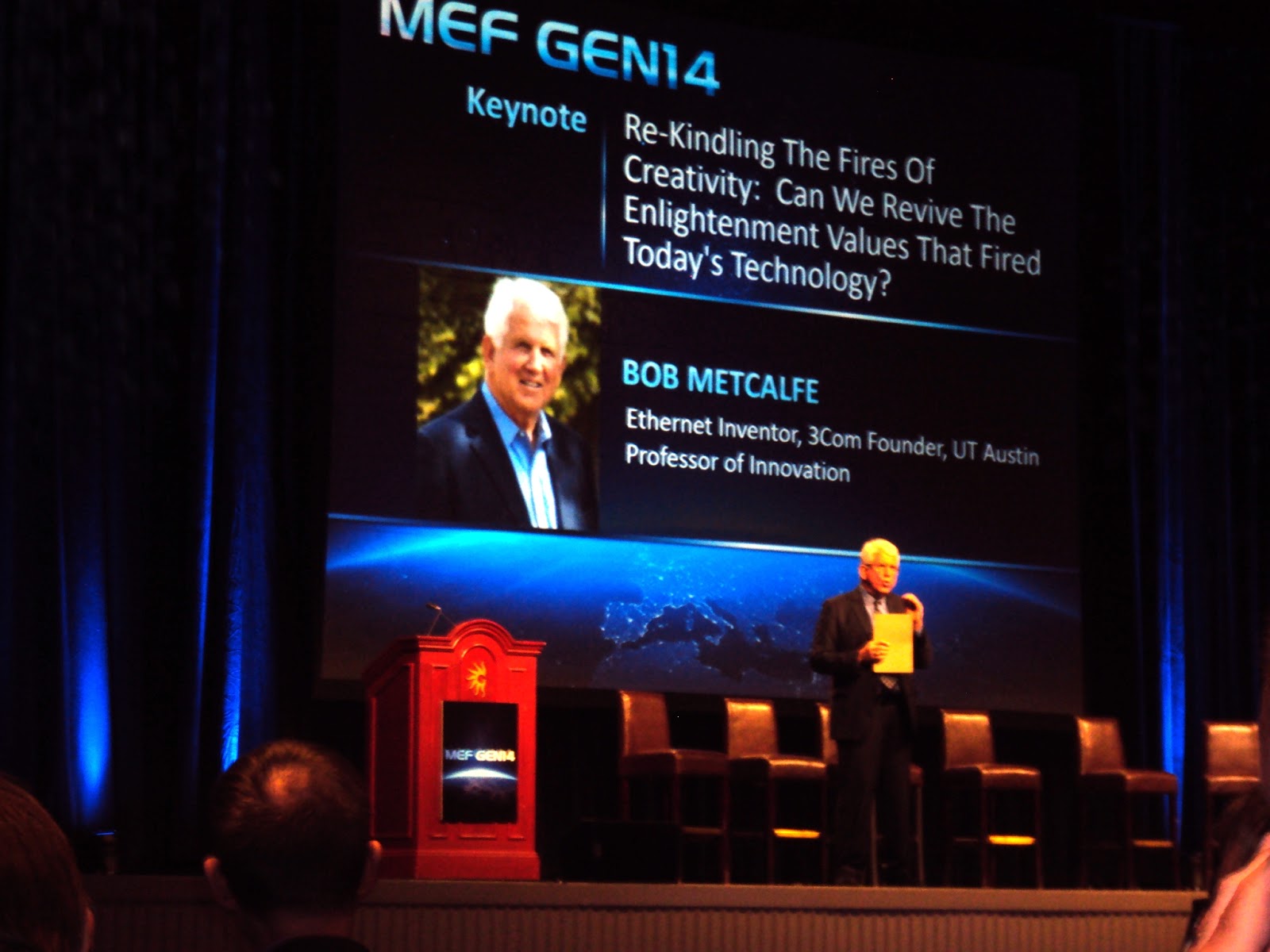
I too had the privilege of listening to Prof. Bob Matcalf’s (Ethernet Inventor, 3Com founder and University of Texas, Austin Professor of Innovation)  keynote on 18th and later meeting him. In his keynote, he opposes net neutrality and talked about Freedom Of Choice Among Competing Alternatives (FOCACA) specially on the NFV and SDN choices. 


The Third Network concept was explained by Nan Chen, President MEF based on Network as a Service (NaaS) principles. Carrier Ethernet 2.0 (CE 2.0) provides assured Quality of Service (QoS) and security. It lacks agility. Internet on the other hand provides on-demand, ubiquitous services without any service assurance. Third Network tries to bring the best of both worlds by providing agility, assurance and orchestration. 

Software-Defined Networking (SDN) and Network Functions Virtualization (NFV) 
As any other conference these days, SDN and NFV played a big role throughout the conference, at leats using the words "SDN" and "NFV" :-) . It was mentioned by one of the speakers that Google manages ~10,000 servers with 1 guy and for a telco its 10 servers managed by 1 guy, which was seen as inefficient. With lots of things discussed about SDN and NFV, somebody viewed the whole thing as Software Defined Operator (SDO) meaning a combination of Internet Protocol (IP), SDN and infrastructure cloud NFV in telco environment.   Software Centric Network (SCN) was another name given to the combination of SDN and NFV. With everyone's talking about SDN and NFV, the question arises: Is software good and hardware bad?”. Almost all viewed SDN as a concept and not as a technology. SDN brings in control and automation, NFV brings cloud to the network, Carrier Ethernet sits in the heart of the access network and Data Center (DC). The financial guys questioned the economic model of SDN and NFV. For some of the participants SDN was "Still Don't Know".

The importance of having a single orchestrator communicating with multiple domain controllers was highlighted. Neela Jacques from Open DayLight shared his thoughts on open SDN and explained that Open DayLight is a community trying to build a common code base. Their charter looks similar to that of Open Networking Foundation (ONF), both talking about the importance of a single entity NOT getting the control of SDN. Cisco explained MPLS-SR (Multi Protocol Label Switching - Segment Routing), showing a halfway SDN migration approach. Going open source and using proprietary SDN was also discussed in the view of vendor lock-in. It looks like having a vendor is also beneficial, if it brings win-win situation. 

While there is a clear shift seen in the industry where operators are moving to IP/Ethernet services/networks from (Time Division Multiplexing) TDM services/networks, it was noted that Ethernet Operation, Administration and Management (OAM) needs improvements compared to TDM’s mature OAM.  Since IP is the end -to-end protocol, it was mentioned that all telecom services can be delivered via IP networks and should be: “everything on IP and IP on everything”. Fiber optics, Dense Wavelength Division Multiplexing (DWDM), Ethernet, IP, MPLS are considered IP helper technologies. In this situation, Open-IX highlighted the importance of having standards for IX/IXP operators. 

In the conference, the current market trend from customer perspective was identified as; on-demand, self-service, elastic, pay-as-you-go/grow and ubiquitous service requirements. It was mentioned that user experience matters in selecting a telecom services like a doctor is selected based on affability, ability and availability. What the telcos really need is something like the Burger King model: Have it your way, where as some operators still look to be operating on other models.


On the mobile and Mobile Backhaul (MBH), it was mentioned that MEF currently doesn’t support Common Public Radio Interface (CPRI) on the front haul. It was also mentioned that MEF22.1 doesn’t address Time of Day (ToD) and phase. This will be addressed in MEF22.2 in the future. 5G was explained by Ericsson as using frequency above 3 GHz (up to 100 GHz) from 2020 to 2030 time frame and coming back to less than 3 GHz frequencies after that. 5G is expected to reduce (compared to 4G) the control traffic  and will introduce the current User Equipment (UE) multi-site connectivity to a multi-layer connectivity. In summary, 5G was viewed as a combination of 10 m cell radius, 1 ms over the air latency, licensed and unlicensed spectrum, 10 Gbps on the air interface requiring Tbps backhaul bandwidth requirements. 

On the video side it was mentioned that 4K video needs 3 times the bandwidth of High Definition (HD) video. Together with big screens it generates even more bandwidth to telco network. On handling bandwidth, it was mentioned that telcos, out of the 2 options (increase bandwidth, optimize bandwidth) have chosen increasing the bandwidth (building capacity) over the years. With regard to meeting the bandwidth requirements, Google fiber, was viewed more as a measure to scare the telecs to build the bandwidth and not that Google really wants to build fiber networks. 

The exhibition area of the GEN14 conference was really good with the participation of lot of vendors and operators. The demonstrations were more on how to use SDN, NFV, orchestration, SDN controllers etc. to achieve more programmable service assurance and fulfilment for telcos, not necessarily for Carrier Ethernet services, but in general for all end-to-end services. Even the vendors like Juniper, who are much strong in hardware, demonstrated NFV (Virtual Customer Premises Equipment (vCPE)). The impact of latency was questioned by the audience. 

The key takeaways of the conference, as explained by Stan Hubbard, MEF GEN14 Program director on closing remarks are; 
  1. Third Network 
  2. Lifecycle Service Orchestration (LSO) (LSO runs from service catalogue to usage)
  3. LSO/SDN/NFV: 3 pillars 
However, I believe that was more from the MEF perspective. On a much general perspective, though the conference discussed about many topics, it looked to me that less was spoken about Carrier Ethernet but more was discussed on challenges faced by the industry in general in doing efficient, effective, productive and profitable business. With SDN, NFV, Cloud and virtualization, lot of things were discussed on how to use these concepts/technologies to achieve those goals.