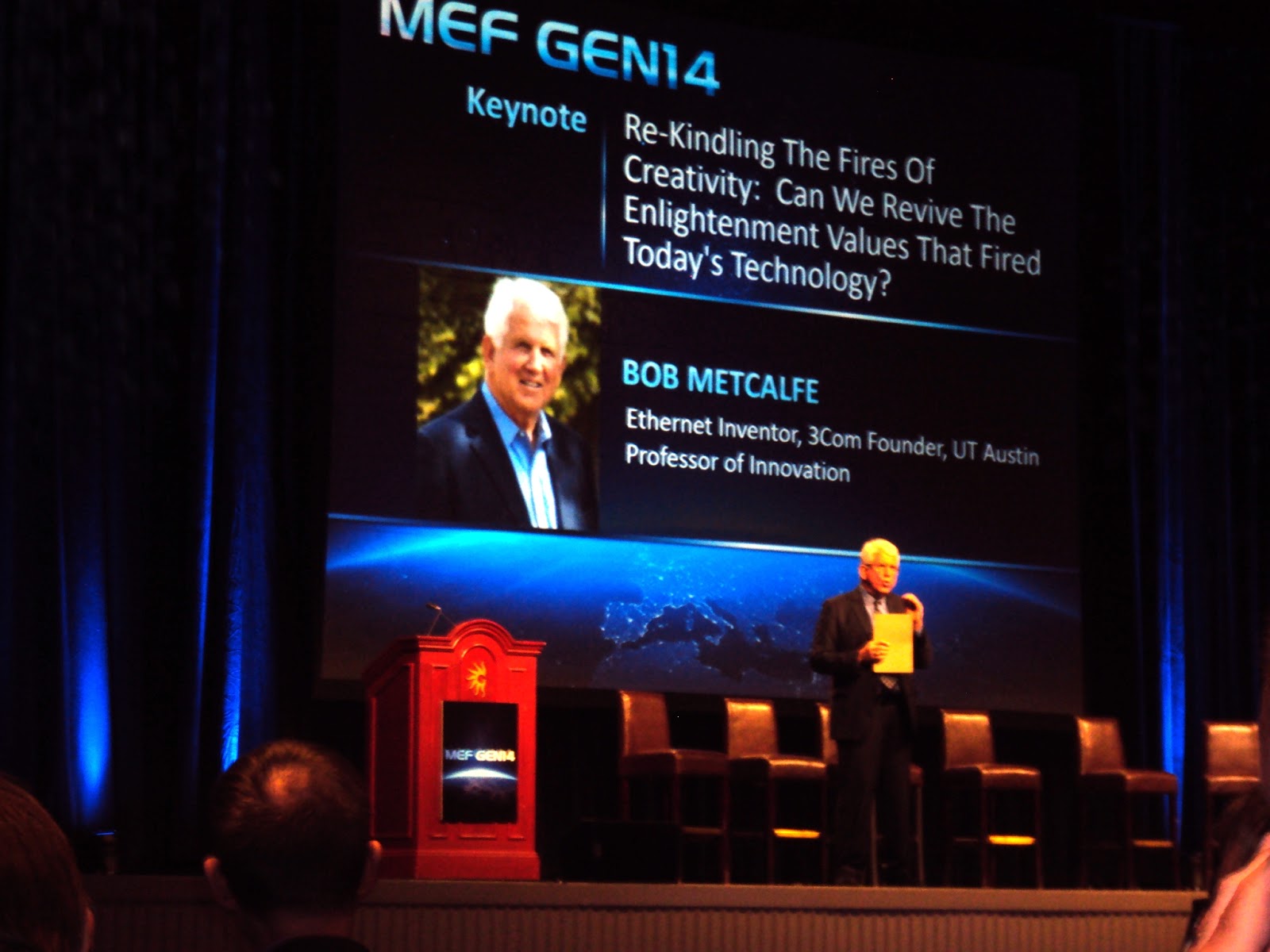
It’s been a while since I wrote my last blog (in November 2014). It was on MEF GEN14. I also attended Carrier Ethernet APAC in December 2014 in Singapore, but couldn't write anything on that. After all, writing a blog at 38,000 feet is always fun (at least for me) and this is the 2nd time I’m doing that. I consider this is one way (next to reading) of using your time productively in long distance flights. It also helps me to recall & summarize the things I gathered during the conference/event and allows me to share that with the others. So, every time I attend a conference outside the region (APAC (Asia Pacific)), you can see me writing. If time permits, I’ll also consider APAC events as well.
Introduction
 This blog is about VNF Management & Orchestration, held at Crown Plaza, Fira Center in the beautiful city of Barcelona from 28th to 29th April 2015. I attended the event as a guest resource person on the invitation of the event organizers- IRR Telecoms & Technology. I delivered a speech on day 1 on “Operator Challenges in Softwarizing Networks” and participated in a panel discussion on “ Round up of SDN (Software-Defined Networking) & NFV(Network Functions Virtualization) initiatives: Where are they now & What has been achieved” together with Alfonso Tierno Sepulveda (Senior Researcher- Network Virtualization Initiative, Telefonica) and Javier Benitez (Senior Network Architect, Colt). The panel was moderated by the Chair of day 1: Paul Parker-Johnson (Practice Lead-Cloud Computing & Virtual Infrastructure Technologies, ACG Research).
On day 2, I participated in another panel discussion on “Ethernet Services: Migration to LSO (Lifecycle Service Orchestration), SDN & NFV”. Together with me, Prayson Pate (CTO, Overture) and Philippe Lalande (Director-Industry Collaborations, Oracle Communications) took part in the panel. The panel was moderated by Daniel Bar-Lev (Director-Certification & Strategic Programs, MEF).
Many interesting things were discussed during the 2 days, which included speeches, panel discussions, speed networking, fireside chats, demo tours in the exhibition area (demos were done by Mavenir, Packet Front Software and Quali Systems), interactive polling sessions and case studies. Reflecting the very change the telco industry is undergoing today (moving from network orientation to IT (Information Technology) orientation), almost all the exhibitors showed almost all their things in software-using computers. The demonstration of Quali Systems (LaaS – Lab as a Service) was done using 5 Raspberry Pis running Debian mounted on a miniature rack made using Lego bricks. It was mentioned that the Lego’s were the most expensive components in their setup and not the computing, storage and networking.
One presented some interesting quotes and 2 of the most interesting ones were;
- Softwarization will gradually and inevitably remove the border between the network and what is connected to it.
- NFV at the edge is the most exciting thing in telecoms since VoIP (Voice over Internet Protocol)
One presented and equation for telco efficiency;
Telco efficiency, S= (∑Revenue) / (∑Capex+ ∑Opex)
It’s obvious that the ultimate target for telcos, or for that matter for anybody running a business, is to keep S>1.
It was interesting to note the number of abbreviations we have today. For example, in the case of letters C, E and P, out of the 6 permutations 3 are used as;
CPE-Customer Premises Equipment
EPC-Evolved Packet Core
PCE – Path Computation Element
The participation in terms of heads in the conference was comparatively less. However, this became a great opportunity for all the participants (most of them were from Europe) to have more interactive, lively and productive discussions and arguments.
SDO (Standard Developing Organization) vs. Open Source
Many things were discussed about standards and SDOs. It was mentioned by some operators that they don’t have money and resources to get participated in SDO/Open Source fora. This is very sad. Another reason for that was the large number of SDO/Open Source fora available today. The independent researchers participated in the conference were of the view that the operators should take the lead role in SDO/Open Source fora, instead of vendors. For example, someone was on the view that OpenDaylight is vendor driven ( and leads to vendor lock-in) and ONLAB/ONOS is researcher/operator driven. It was also mentioned that the open source projects like Linux and OpenStack were initiated to solve a problem; whereas today’s open source projects related to SDN/NFV/Softwarization look competing with each other. One of the reasons for the proliferation of many open source initiatives is the release of their readily usable source code instead of just pdf documents produced by SDOs (pdf vs. python). This has led to the open source outcomes become de-facto standards. After all, standards are as good as their adoption.
In the open source debate, it was asked who takes the responsibility and risk, in case of a problem occurs in a deployed open source software in a telco network with business services with SLAs (Service level Agreements) running (compared to NO QoS (Quality of Service) services OTT (Over The Top) operators are running). Telcos need quick support when a problem occurs. One example is the Linux distribution from RedHat. Linux source code is open source. RedHat charges the users for taking the said risks associated with open source and this creates a win-win situation for both RedHat and end users. Similar example is OpenDaylight controller offering from Brocade (Brocade Vayatta Controller) (Brocade calls this Quality-assured version of the OpenDaylight Controller).
Orchestration
Many things were discussed about orchestrators (service orchestrator, network orchestrator, Business orchestrator (MEF), etc.), managers and controllers too. It looked to me that there’s a confusion on definition of these terms/functions and how these (either physically or virtually) is placed in the overall architecture (ex:- Orchestrator/s at the top, manager/s in the middle and controller/s at the bottom or any other order. The option of having a flat architecture instead of the existing hierarchical architecture was also proposed).
PT (Portugal Telecom) said that they use their own orchestrator. Their argument was that the open source and vendor specific orchestrators today are not modular (if modular, we can re-write processes). One participant to the analogy of a car fleet for the modules (pods), saying that if you have more requirement, you add more cars to the fleet rather than making your cars big.
DevOps (Development and Operations)
DevOps, which is actually coming from the IT world, has been discussed a lot during the conference. DevOps has now become a standard component in the telco filed (Ex:- Cisco DevNet). According to the 2014 CA Technologies survey, Telecoms was the industry with most aggressive intent to adopt DevOps.
Adoption
We see lot of competition coming to operators/telcos from OTT players like Facebook, Google and Amazon in today’s cloud/virtualization/SDN world. However, it was noted that in terms of the [service] flows, the OTTs are at the end of the flow, whereas the telco SDN is part of the flow.
Under the overall umbrella of next telco transformation in softwarizing/softwarization, many things came into the picture: SDN, NFV, VNF, orchestration, etc. However, it was the view of the participants that NFV and VNF were the 1st things that telcos would move into in the network side. SDN, which was started inside DCs (Data Centers), is expected to move slowly into telco networks.
In terms of adoption of SDN/NFV/softwarization, it was of the view of the participants that, while the Tier 1 operators do most of the shouting and leading the standards/standardization efforts, the real deployments will mostly come from the mid-size operators (Tier 2) as it’s easy for them to deploy (due to comparatively small network size) and also, they can get market share. Tier 3 operators will mostly will take the wait and see/follower approach.
Conclusion
As I feel, the conference ended leaving lot of things in the participants’ minds to think. Though SDN/NFV/softwarization is no more a hype, we are yet to see considerable number of money making/saving success stories from telcos. That’s all for the moment. Until next time, good bye.