Showing posts with label TDM. Show all posts

Wednesday, November 26, 2014

MEF GEN14 update

It’s been more than a year since I wrote my last blog post. I was busy with other work (office, teaching, speaking, reading, traveling, advising, consulting, family…. ) and couldn’t really find a time to write something, though I had lot of things to share. However, I kept on my micro-blogging activities on twitter as usual. This post is actually a summarization about Metro Ethernet Forum (MEF) Global Ethernet Networking (GEN) 14 (MEF GEN14). 


I attended the 1st ever MEF GEN14 conference from 17th to 20th November 2014 at Gaylord National Resort and Convention Center at National Harbor waterfront entertainment district, located eight miles south of Washington DC, USA. On 17th, I had the privilege of attending the MEF Certified Professional’s convention as a guest resource person. Together with Marjory Sy (Carrier Ethernet Technical Lead, PLDT) and Sendang Praptomo (Telin, Singapore), I participated in the panel discussion ”Evolution of the Carrier Ethernet Professionals Community”. The panel was moderated remotely Dr. Vishal Sharma (Metanoia) together with on-site support of Daniel Bar-Lev (Director Certification/Strategic programs, MEF). The unique thing was that all of them are members of the LinkedIn Carrier Ethernet Group. 


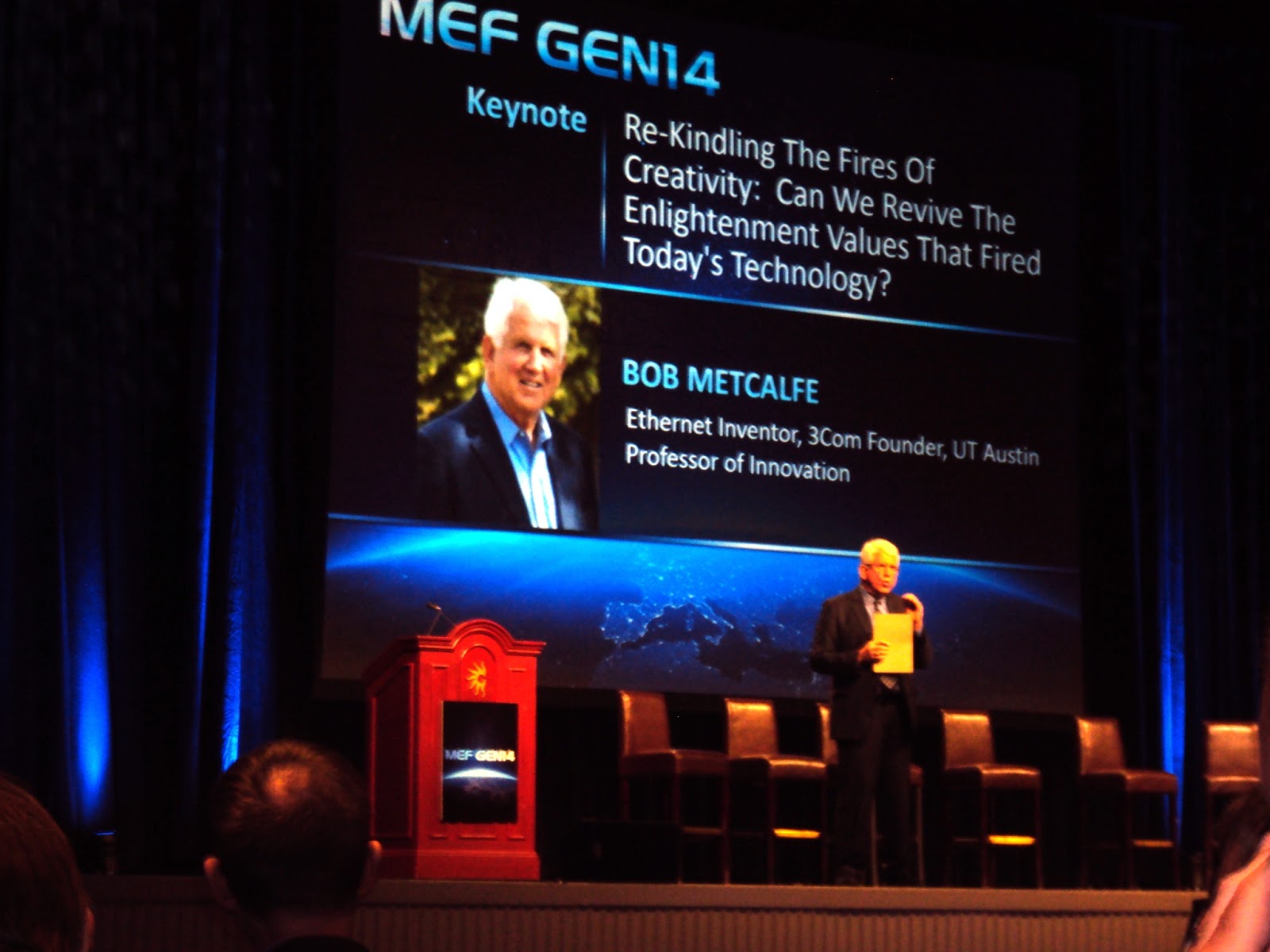
I too had the privilege of listening to Prof. Bob Matcalf’s (Ethernet Inventor, 3Com founder and University of Texas, Austin Professor of Innovation)  keynote on 18th and later meeting him. In his keynote, he opposes net neutrality and talked about Freedom Of Choice Among Competing Alternatives (FOCACA) specially on the NFV and SDN choices. 


The Third Network concept was explained by Nan Chen, President MEF based on Network as a Service (NaaS) principles. Carrier Ethernet 2.0 (CE 2.0) provides assured Quality of Service (QoS) and security. It lacks agility. Internet on the other hand provides on-demand, ubiquitous services without any service assurance. Third Network tries to bring the best of both worlds by providing agility, assurance and orchestration. 

Software-Defined Networking (SDN) and Network Functions Virtualization (NFV) 
As any other conference these days, SDN and NFV played a big role throughout the conference, at leats using the words "SDN" and "NFV" :-) . It was mentioned by one of the speakers that Google manages ~10,000 servers with 1 guy and for a telco its 10 servers managed by 1 guy, which was seen as inefficient. With lots of things discussed about SDN and NFV, somebody viewed the whole thing as Software Defined Operator (SDO) meaning a combination of Internet Protocol (IP), SDN and infrastructure cloud NFV in telco environment.   Software Centric Network (SCN) was another name given to the combination of SDN and NFV. With everyone's talking about SDN and NFV, the question arises: Is software good and hardware bad?”. Almost all viewed SDN as a concept and not as a technology. SDN brings in control and automation, NFV brings cloud to the network, Carrier Ethernet sits in the heart of the access network and Data Center (DC). The financial guys questioned the economic model of SDN and NFV. For some of the participants SDN was "Still Don't Know".

The importance of having a single orchestrator communicating with multiple domain controllers was highlighted. Neela Jacques from Open DayLight shared his thoughts on open SDN and explained that Open DayLight is a community trying to build a common code base. Their charter looks similar to that of Open Networking Foundation (ONF), both talking about the importance of a single entity NOT getting the control of SDN. Cisco explained MPLS-SR (Multi Protocol Label Switching - Segment Routing), showing a halfway SDN migration approach. Going open source and using proprietary SDN was also discussed in the view of vendor lock-in. It looks like having a vendor is also beneficial, if it brings win-win situation. 

While there is a clear shift seen in the industry where operators are moving to IP/Ethernet services/networks from (Time Division Multiplexing) TDM services/networks, it was noted that Ethernet Operation, Administration and Management (OAM) needs improvements compared to TDM’s mature OAM.  Since IP is the end -to-end protocol, it was mentioned that all telecom services can be delivered via IP networks and should be: “everything on IP and IP on everything”. Fiber optics, Dense Wavelength Division Multiplexing (DWDM), Ethernet, IP, MPLS are considered IP helper technologies. In this situation, Open-IX highlighted the importance of having standards for IX/IXP operators. 

In the conference, the current market trend from customer perspective was identified as; on-demand, self-service, elastic, pay-as-you-go/grow and ubiquitous service requirements. It was mentioned that user experience matters in selecting a telecom services like a doctor is selected based on affability, ability and availability. What the telcos really need is something like the Burger King model: Have it your way, where as some operators still look to be operating on other models.


On the mobile and Mobile Backhaul (MBH), it was mentioned that MEF currently doesn’t support Common Public Radio Interface (CPRI) on the front haul. It was also mentioned that MEF22.1 doesn’t address Time of Day (ToD) and phase. This will be addressed in MEF22.2 in the future. 5G was explained by Ericsson as using frequency above 3 GHz (up to 100 GHz) from 2020 to 2030 time frame and coming back to less than 3 GHz frequencies after that. 5G is expected to reduce (compared to 4G) the control traffic  and will introduce the current User Equipment (UE) multi-site connectivity to a multi-layer connectivity. In summary, 5G was viewed as a combination of 10 m cell radius, 1 ms over the air latency, licensed and unlicensed spectrum, 10 Gbps on the air interface requiring Tbps backhaul bandwidth requirements. 

On the video side it was mentioned that 4K video needs 3 times the bandwidth of High Definition (HD) video. Together with big screens it generates even more bandwidth to telco network. On handling bandwidth, it was mentioned that telcos, out of the 2 options (increase bandwidth, optimize bandwidth) have chosen increasing the bandwidth (building capacity) over the years. With regard to meeting the bandwidth requirements, Google fiber, was viewed more as a measure to scare the telecs to build the bandwidth and not that Google really wants to build fiber networks. 

The exhibition area of the GEN14 conference was really good with the participation of lot of vendors and operators. The demonstrations were more on how to use SDN, NFV, orchestration, SDN controllers etc. to achieve more programmable service assurance and fulfilment for telcos, not necessarily for Carrier Ethernet services, but in general for all end-to-end services. Even the vendors like Juniper, who are much strong in hardware, demonstrated NFV (Virtual Customer Premises Equipment (vCPE)). The impact of latency was questioned by the audience. 

The key takeaways of the conference, as explained by Stan Hubbard, MEF GEN14 Program director on closing remarks are; 
  1. Third Network 
  2. Lifecycle Service Orchestration (LSO) (LSO runs from service catalogue to usage)
  3. LSO/SDN/NFV: 3 pillars 
However, I believe that was more from the MEF perspective. On a much general perspective, though the conference discussed about many topics, it looked to me that less was spoken about Carrier Ethernet but more was discussed on challenges faced by the industry in general in doing efficient, effective, productive and profitable business. With SDN, NFV, Cloud and virtualization, lot of things were discussed on how to use these concepts/technologies to achieve those goals.

Wednesday, July 10, 2013

Circuit to Packet and back to Circuit

In early days when most of us were not born,
operators built TDM (circuit) networks and offered data (circuit) services to customers.
Because customers wanted data(packet) services,
operators built IP/Ethernet (packet) networks.
Now customers ask for circuit like services again.
But, operators can’t build circuit networks again.
Operators have no choice than allowing circuit like services flow in their packet networks.


By Anuradha Udunuwara

Wednesday, September 12, 2012

When and why you should move to Carrier Ethernet?

First things first, I would suggest the Communication Service Provider (CSP) should critically analyze the book value of the existing legacy system, spare capacity availability, vendor support availability, Next Generation Network (NGN)/Ethernet transport feature availability, upgrade costs and operational costs like space and power. As long as the existing system addresses the requirement cost effectively in short term and mid term, I would suggest that the CSP continue with the legacy system with a clear replacement/migration plan for long term.

I'll now list 2 important highlights below to show you why I would replace an existing legacy (ex:- SDH) network with a Carrier Ethernet (CE) network.

(1) *Native* support of cost effective and ubiquitous Ethernet interface/service/transport

As you know the current and future traffic on CSPs are more towards IP/Ethernet and this requires that CSP
1. provide "Ethernet interfaces" to customers,
2. transport/provide "Ethernet Services" like MEF E-LINE, E-LAN, E-TREE and E-Access,
3. build "Ethernet based transport networks" like Carrier/Metro Ethernet MANs/WANs.

If you are to transport Ethernet over SDH, you require EoSDH capabilities on your SDH platforms. On the other hand, for you to transport TDM over Ethernet, you require
Circuit Emulation Service over Packet Switched Networks (CESoPSN)/Structure Agnostic Transport over Packet (SAToP). Since the trend is now to move from legacy (TDM) to NGN (IP/Ethernet), you will see more IP/Ethernet than TDM in the future. So it's logical to have CE with TDMoEthernet, rather than having SDH with EoSDH. Finally all will converge to CE.

(2) Vendor support

As these trends happen in the CSP ecosystem (CSPs, OEMs, SDOs etc.), the vendors are also discontinuing legacy systems and move to NGN based technologies like CE. This will make the cost of legacy systems high and cost of NGN systems low due to the economies of scale. This will also made the support (AMC- Annual Maintenance Contract) charges for legacy systems be also high.

Thursday, July 26, 2012

Future of wire-line access networks

Introduction
Communication Service Provider (CSP) networks can be divided into many categories. If divided based on the media used for the transport, wired and wireless are the widely known. Both types can be again sub divided based on the functional hierarchy; core, aggregation and access. If wired networks are concerned, optical fiber is used in almost all the core and aggregation networks because of its ability to carry/transport large amounts of data.
Wire line CSP access networks can be built using cable, copper or optical fiber. The cable based access networks are common in North America. Countries like Sri Lanka are more used to copper and fiber based access networks.
Access networks can again be classified based on the customer segment. While it is simple to have a single access network for both residential and business customers, some CSPs build different access networks for these 2 segments. The requirements and expectations of the 2 segments are different.

Design Criteria
A best practice in any access network design is to start with some forecasted marketing data. The networks that we build today should be future proof as far as possible in terms of service demand and technology used. For an example, for a residential triple play access network, it is better to have some figure on the number of customers per area, type of services required by those customers, the bandwidths consumed for each service and the bandwidth per house hold. Based on this information, we can find out the immediate bandwidth requirement per customer and the future demand. While there are many differences between fiber and copper based access networks, the fundamental difference is the ability of fiber to carry large amounts of data. Optical fiber networks in that sense are very much future proof.
It is always a good idea to design the networks for your real requirement rather than going behind various technologies. A technology used in United States (US) or Europe may not be able to directly deployed in countries like Sri Lanka.
The main decision factors when deciding on an access network technology/media are cost per user, bandwidth demand and demographic criteria. The current trend is to deliver more bandwidth per user in a secure way at lower cost.

Copper or fiber
If copper is already laid and available to the households, then it will be a good idea to use them if the required bandwidths can be delivered using them. The fundamental problem of copper based access is the decaying of speed with the distance. Most of today’s copper based access networks start from the Central Office (CO) of the CSP and goes to the customer. The access network is fully passive, consisting of, but not limited to, Main Distribution Frame (MDF), primary cable, Cabinet, secondary cable, Distribution Point (DP) and overhead cable. The popular Digital Subscriber Line (DSL) technologies are struggling to deliver high bandwidths when the distance between the CO and the customer increases.
One solution is to use optical fiber, instead of copper. But the main problem of copper, as identified earlier, is the decaying of speed with distance. While it is accepted that the ideal solution is to have fiber, we can also try to shorten the copper length and deliver high bandwidths. This will save lot of cost as fiber is not freshly drawn.  This introduces a new term called FTTX, Fiber To The “place you want”. X could be building, home, curb/cabinet, node or even desk. So now the issue is between FTTH and FTTC/B.

Optical access networks
Optical access networks could be active or passive. An example of an Active Optical Network (AON) is Metro Ethernet or Carrier Ethernet. Here, active Ethernet switches are deployed in the network to deliver services, mainly to business customers. The networks mostly take the form of rings assuring high availability required by business critical applications.
The other category is Passive Optical Networks (PON).  PON works by delivering an end to end fiber access to the building or home. Though PON can be used for FTTC/N applications, most PON applications are based on FTTH/B architecture. Unlike AON, PONs have limited network protection in the last mile, because of its passive nature. PON works by dividing an optical signal into multiple fibers using a passive optical splitter. After the splitter, the network is liner and does not provide any direct protection. This type of a solution is mainly suitable for a residential rather than business.
The Table 1 below gives a snapshot of various PON technologies.


TDM PON
WDM PON


Hybrid TDM / WDM PON

ATM PON (APON) =Broadband PON(BPON)
=A/B PON
Ethernet PON (EPON)
= Gigabit Ethernet PON (GEPON )
Gigabit PON (GPON)

ITU-T G.983 standard
IEEE 802.3ah standard
ITU-T G.984 standard

Still at research stage

Developed from Telco side
Developed from Internet side

Evolved from A/B PON

Evolution from TDM PON

Layer 2 encapsulations are Ethernet and Asynchronous Transfer Mode (ATM)
Layer 2 encapsulation is Ethernet
L2 encapsulations are GEM(GPON Encapsulation Method) for Ethernet and ATM


Maximum up stream is 155Mbps, Maximum downstream is 622Mbps
Maximum up stream and downstream is 1.25Gbps
Maximum up stream and downstream is 2.5Gbps
Maximum up stream and downstream is 10 Gbps
Deployments: US (ex: Verizon FiOS)
Deployments: Japan (ex: NTT, KDDI), Korea (ex: KT), China, India

Deployments: US (ex: AT&T), Europe

Deployments: Korea (ex: KT), China

Table 1. PON technology comparison.
TDM PON is the current choice because of its low cost. Out of the available TDM PON technologies, GPON has much better multi-service capabilities and carrier grade management capabilities and therefore the winning technology. It is also future proof, because of its high bandwidth support.